
AT&T regretted buying Warner Bros. Discovery is selling after three years. Is Netflix next?
I spent this evening reading through the full Netflix and Warner Bros. Discovery transaction announcement , the deal terms, the collar mechanics, the board approvals, all of it. On the surface, it’s a beautiful deal. You’re taking the deepest library in Hollywood and handing it to the only platform on earth that actually knows how to distribute global content at scale. The logic is clean. The assets are iconic. The synergy story is real.
After reading the full transcript, if you asked a banker to design the “perfect” media consolidation play, it would probably look like this
The Deal Logic
Netflix gets what it could never build from scratch
Netflix gets what it could never build from scratch: HBO’s unmatched prestige brand, Warner Bros.’ century-long film legacy, franchises like DC, Harry Potter, Game of Thrones, and Lord of the Rings, plus a library that lowers churn and expands international monetization.
WBD shareholders get what they haven’t had in a decade: liquidity, strategic clarity, and a home for the assets that isn’t constantly restructuring itself.
So yes, on a whiteboard, this deal is compelling.
The Deal Mechanics
The Numbers,
- Enterprise value of approximately $83 billion
- Equity value of $72 billion (roughly 20% premium on current stock price)
- Deal expected to close in Q3 2026, after WBD spins off cable assets (CNN, TNT Sports, Discovery channels) into a separate public company called Discovery Global
- Netflix committed to maintaining HBO Max and theatrical releases for Warner Bros. films
- Warner Bros. currently generates $3 billion in EBITDA; Netflix expects to add $2.5 billion in synergies for a combined $5.5 billion EBITDA target
- Post-synergy acquisition multiple: 14.3x EV/EBITDA
- $27.75 per WBD share ($23.25 cash + $4.50 Netflix stock with a collar)
What the collar tell us? Both parties see meaningful execution risk. Netflix is worried about downside protection. WBD wants upside participation. The collar is basically a hedged bet that this could go either way.
What management emphasized on the call: CFO Spence Neumann made clear those $2-3 billion in annual synergies are “mostly SG&A” – overlapping support functions and tech stack consolidation, not primarily content savings. Warner Bros. will continue operating largely as is, including their third-party production business (making shows for other platforms) and their theatrical release model.
This tells you Netflix isn’t planning a radical restructuring. They’re betting the assets are more valuable in Netflix’s distribution system, not that they need to gut Warner Bros. to make the math work.
Why the Industry Was Always Heading Here
This deal doesn’t exist in a vacuum. It’s part of a larger pattern that’s been building for years: the end of standalone studios and the rise of global-scale content networks.
We’ve already watched the ecosystem consolidate step by step:
- Disney and Fox
- Amazon and MGM
- Microsoft and Activision
Everyone is converging toward the same unavoidable end state: a triopoly of global entertainment platforms that own IP, distribution, and subscriber relationships.
This Netflix–WBD deal accelerates that trajectory. It might even be the final domino that pushes the industry into its long-term equilibrium.
Why Now?
When asked directly on the call, Ted Sarandos gave the most honest answer possible: “It wasn’t for sale before.” Warner Bros. Discovery hadn’t “cleaned up the assets or separated the assets” until now.
But there’s more to it. Netflix’s stock is near all-time highs.
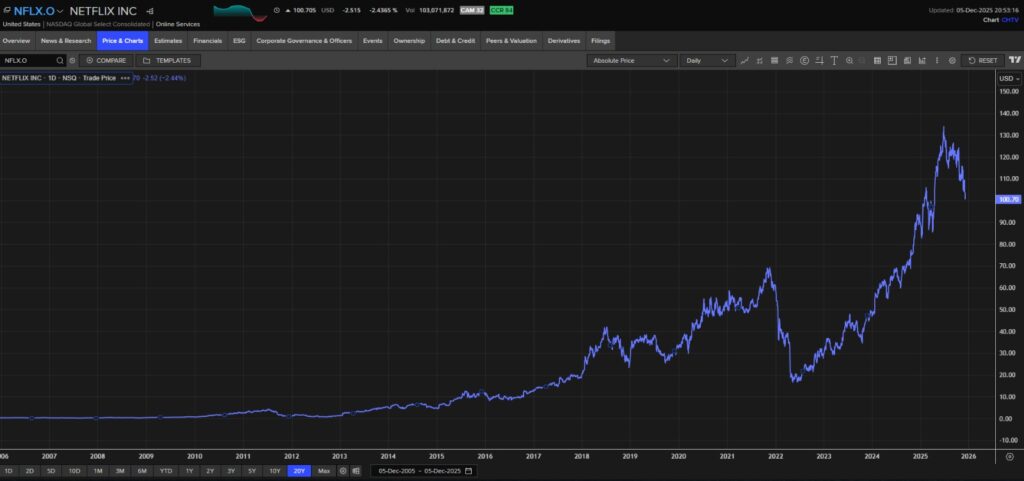
Free cash flow turned positive. Cost of capital is as low as it will ever be. This might be the only window where they could finance an $82.7 billion acquisition without destroying their balance sheet.
Five years ago, Netflix was burning $3 billion annually. Five years from now, who knows what rates look like or whether their growth story still commands a premium multiple.
According to Ted, the bidding was “incredibly rigorous and competitive.” They sound “a little tired” because the process was intense. Netflix won, but they had to fight for it.
The industry has been consolidating toward a triopoly of global platforms (Disney-Fox, Amazon-MGM, Microsoft-Activision). This might be the final domino.
Greg Peters Said Media Mergers Don’t Work
Two months ago, co-CEO Greg Peters said there’s “a long, long history of media transactions that do not end well.”
On today’s call, he addressed this directly. “Historically, many of these mergers haven’t worked, some have, but you really got to take a look at this on a case by case basis.” He argues Netflix is different because they understand entertainment (unlike AT&T), they’re not a dying business looking for a lifeline, and they have a clear thesis.
Maybe he’s right. But every acquirer thinks they’re different. AT&T thought they understood content distribution. Discovery thought they understood Warner Bros. better than anyone.
The pattern: confidence before the deal, chaos after it closes.
Warner Bros. has been passed from owner to owner like a hot potato for a reason. It’s a brilliant asset with a chaotic operating model and volatile earnings. Now Netflix is stepping into the same maze , taking leverage from near-zero to 3x to do it.
Warner Bros. employs 17,500+ people across multiple business units and geographies. HBO alone has 2,000 employees with a culture of creative autonomy that’s practically religious. Netflix has 14,000 employees with a radically different culture: data-driven, algorithm-optimized, streaming-first.
Where This Could Go Wrong
The HBO Integration Mystery
On the call, when asked about HBO’s future, Greg Peters gave the most carefully vague answer possible: “It’s quite early to get into the specifics of how we’re going to tailor this offering for consumers.”
He doesn’t know yet.
He confirmed the HBO brand is “very powerful” and would “constitute part of our plans,” but wouldn’t say whether HBO remains a separate service or becomes a hub within Netflix.
HBO’s value is inseparable from its brand identity and creative autonomy. Netflix-ify HBO and you destroy the asset. Keep HBO completely separate and the synergies evaporate. Pick one.
The Theatrical Release Problem
Netflix has committed to maintaining Warner Bros.’ theatrical release model.
Netflix built its entire identity around rejecting theatrical windows. They’ve fought with theater chains for years. They’ve conditioned subscribers to expect everything immediately. Their algorithms, content strategy, marketing , everything is optimized for streaming-first.
Ted Sarandos tried to smooth this over: “We’ve released about 30 films into theaters this year.” But those were limited releases, art house plays, awards positioning. Not tentpole blockbusters with 45-90 day exclusive theatrical windows.
Warner Bros. releases 15-20 major theatrical films per year with traditional windows. Each one forces Netflix to choose: prioritize theatrical and anger subscribers who expect immediate access, or prioritize streaming and watch billions in box office revenue evaporate.
Ted says Warner Bros. films will continue as planned. He also says Netflix’s “primary goal is to bring first-run movies to our members.”
Both can’t be true. The most likely outcome is a slow, painful compromise that satisfies nobody. Shorter windows that alienate exhibitors. Delayed releases that frustrate subscribers. A hybrid model that destroys value on both sides.
The Third-Party Production Conflict
Warner Bros. Television will continue producing content for third parties , Netflix’s competitors.
Ted confirmed this: “They’re quite successful at it, and we want to keep that successful business operating.”
Warner Bros. will keep making shows for Apple TV+, Amazon Prime, Disney+. Why would Warner Bros. give its best projects to Netflix when they could sell them to the highest bidder? The incentive structure breaks.
The Regulatory Risk
Netflix would control 45-50% of the U.S. premium streaming market post-acquisition. Unprecedented market power.
Ted said they’re “highly confident” because “this deal is pro consumer, pro innovation, pro worker.” That’s the script every acquirer reads. AT&T said the same thing.
The FTC will scrutinize market concentration, vertical integration (Netflix owns production, content, distribution, and customer relationships), and licensing leverage. Approval is likely but not guaranteed.
My odds: 70% approval with conditions, 20% major concessions, 10% blocked
If Integration Goes Wrong
Talent flees HBO. Creative executives, showrunners, and producers work there because it’s HBO. Impose data-driven mandates or algorithmic decision-making and the best talent walks. Lose the people who greenlit Succession and The Last of Us and you’ve destroyed the primary asset.
EBITDA misses follow. Netflix is projecting $2.5 billion in synergies by year three. Integration costs run higher, subscriber growth stalls, theatrical revenue collapses , suddenly 3x leverage becomes 4x. Credit ratings get cut. Borrowing costs rise. The promised accretion evaporates.
Operational miss, leverage spike, strategic flexibility evaporates, more operational misses.
What Success Looks Like
If Netflix executes well:
HBO remains HBO, but supercharged. The brand stays autonomous with its own creative leadership, backed by Netflix’s $17 billion content budget and 280+ million global subscribers. Succession and The Last of Us still feel like HBO, but launch simultaneously in 190 countries with Netflix’s marketing machine.
The DC Universe gets the Marvel treatment. Netflix finally has franchise tentpoles to compete with Disney+. Ten-year interconnected universe across film and streaming, theatrical releases for major entries, limited series filling gaps.
Warner Bros.’ development infrastructure accelerates Netflix’s hit rate. Ted emphasized this repeatedly: Warner Bros. has “a hundred years of creative and development experience” while Netflix has been at it “for a little over a decade.” Ted admitted Netflix’s “deep development pool is quite shallow.” Warner Bros. changes that. Examples: K-pop Demon Hunters (Sony passed), People You Meet on Vacation (from deep development pool).
Netflix becomes the Disney of streaming: vertically integrated, irreplaceable IP, global distribution, pricing power. Worth $82 billion. Maybe more.
The Critical Milestones
Q3 2026: Discovery Global spinoff completes (prerequisite)
Q4 2026-Q1 2027: Regulatory review intensifies (watch for Second Requests)
Early 2027: WBD shareholder vote (watch for activist pushback)
Mid 2027: Integration planning visible (HBO leadership decisions signal everything)
Q2-Q3 2027: Transaction closes, leverage spikes
2028-2029: Synergy realization or value destruction (year two EPS accretion promised)
The Bottom Line
Can Netflix integrate a 100-year-old Hollywood studio without destroying what makes it valuable?
If yes, this redefines the industry.
If no, we watch the same movie for the fourth time: tech company buys legacy media asset, underestimates cultural integration, imposes wrong operating model, bleeds talent, misses synergies, destroys shareholder value.
AT&T regretted buying Warner Bros. Discovery is selling it after three years. Netflix thinks they’re different.
I give this deal 60/40 odds of success , better than AT&T-Time Warner (which never had a chance), worse than Disney-Fox (which had clear strategic alignment). Netflix has the financial strength and strategic vision that AT&T lacked, but they’re attempting something harder: merging two fundamentally incompatible business cultures while maintaining theatrical operations they’ve spent years opposing.
Greg Peters is right that Netflix understands entertainment in ways AT&T never did. But understanding entertainment and successfully integrating a century-old studio while preserving its culture are different things.
The next 18 months will tell us whether Ted Sarandos and Greg Peters are visionaries who saw what others missed, or the latest executives to learn that Hollywood doesn’t consolidate as cleanly as the spreadsheet suggests.
Check back in 24 months.
Credit: Rayane El Hannouti